When a child walks into a classroom, their ability to learn doesn’t solely depend on the textbook in front of them or the lesson being taught. Academic growth requires a broader framework—one that encompasses a student’s health, family stability, mentorship, and a deep sense of safety and belonging.
At Refugee Hope Partners, our programs are intentionally designed around this framework. Our mission is driven by compassion and relationship, and is grounded in the core value of holistic care for the whole family, to move from arriving to thriving.
Recently, RHP Board Member Mark Savage, a former Wake County Area Superintendent, presented a deep dive into the research that supports our educational programs. His insights highlighted how evidence-based strategies, paired with consistent mentorship, can help create meaningful academic and life outcomes for refugee students and their families.
Here is a closer look at these findings and how they shape the way we walk alongside refugee families.
Homework Help
Refugee students often face the challenge of learning a new culture, navigating an unfamiliar school and academic system, and sometimes learning a new language—all while trying to keep up with grade-level coursework. This can be exhausting and daunting, especially when they are learning alongside students who have grown up familiar with these systems.
These challenges can create academic gaps that cannot always be addressed within a typical seven-hour school day. Closing those gaps requires dedicated time, one-on-one attention, and a trusted adult who believes in a student’s potential.
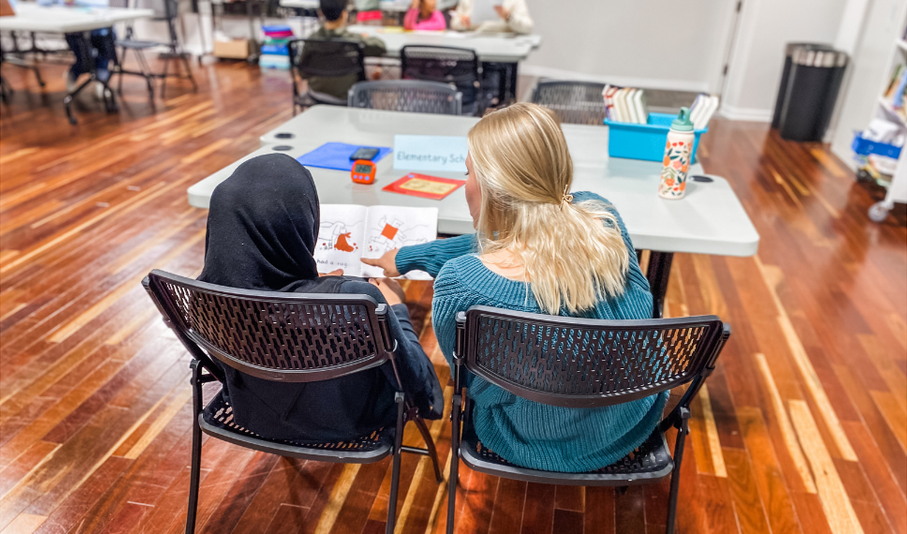
Through our Homework Help Program, students receive academic support from dedicated volunteers. For many, this may be one of their few opportunities to receive sustained, individualized attention outside the classroom. Beyond helping with homework, volunteers encourage and help students build confidence, recognize their resilience, and foster the skills needed to succeed.
Research from the National Student Support Accelerator has found that high-impact tutoring can produce substantial learning gains equivalent to 3–15 additional months of learning. For students working to adapt to a new language and educational system, that additional learning time can help close critical academic gaps.
Consistency matters. Homework help is more than helping a student complete their assignment that night. Sustained tutoring can accelerate learning trajectories and give students who have fallen behind a pathway back toward staying on grade-level.
Mentoring
The years leading to graduation involve major decisions: whether to attend college or enter the workforce, pursue community college or a four-year university, and which career path to pursue. These choices can shape a young person’s sense of identity and are often intertwined with cultural and familial expectations. For refugee youth building a life in a new country, navigating these choices can involve additional systemic barriers, and working through these choices is not meant to be done alone.
Our Bridge Mentoring Program pairs high school juniors and seniors with caring adult mentors who serve as advocates, listeners, and guides. Together, they explore career and college opportunities, set goals, fill out applications and paperwork, and prepare for life after high school.
Research from The Mentoring Effect has found that young people with a mentor are 55% more likely to enroll in college and 78% more likely to volunteer regularly and hold leadership roles within their communities.
Mentorship gives young people a relationship they can rely on as they make decisions about their future. A mentor provides reassurance in daunting decisions, highlights their students strengths, and helps them envision opportunities they may not have considered before.
And these relationships are inherently cyclical. When young people experience someone consistently investing in their personal growth, it inspires them to pay that investment forward. Former mentees naturally become mentors themselves by seeking relationships that impacted them initially. They become leaders that pour into their own communities.
Medical Ministry & Basic Needs Support
A student cannot fully focus on reading comprehension or algebra while facing food insecurity, untreated health concerns, or significant stress.
The Harvard Center on the Developing Child has emphasized the importance of safe, supportive environments for children and the impact of stress on learning:
“If a child is preoccupied with fears or anxiety, or is dealing with considerable stress, no matter how intellectually-gifted that child might be, his or her learning is going to be impaired by that kind of emotional interference.”
When a child’s basic needs are met and their environment is stable and supportive, they are better positioned to engage the cognitive skills required for learning.
Students are in tandem affected by ongoing health or other difficulties their parents or caregivers face. One example is a student may miss school because a parent or caregiver is unable to provide transportation, attend a medical appointment, or be preoccupied managing other family needs.
Chronic absenteeism stands as one of the single strongest predictors of lower academic achievement and school dropout. Research from Attendance Works reveals that missing just two days of school per month places a student at risk of falling behind academically.
RHP’s Medical Ministry and Basic Needs Support works to directly address these barriers. By helping families gain access to health care, schedule medical appointments, and obtain transportation, we seek to help families remain healthy and stable, and keep students engaged in school.
Adult Education
Educational success is rarely an individual journey; it involves the whole family. When parents and caregivers have the tools and confidence to engage with their children’s schools, the entire household benefits.
Through our Adult ESL Program and active partnership with Wake County Public Schools, RHP works to strengthen the educational capacity of the entire family.
Learning English can help refugee parents communicate more effectively with teachers, navigate school communication, understand the academic expectations, and become more active participants in their students’ education.
Research from the Education Endowment Foundation has also found that effective family engagement can accelerate student learning progress by the equivalent of 2 to 3 additional months in an academic year.
When we equip parents, we strengthen families. When we strengthen families, we create conditions in which children can thrive.
At Refugee Hope Partners, we believe research provides the roadmap, but relationships provide the engine.
As educator Rita Pierson famously said:
“Every kid deserves a champion…an adult who will never give up on them, who understands the power of connection, and insists that they become the best that they can possibly be.”
That conviction sits at the very heart of Refugee Hope Partners.
When researched strategies meet committed staff, volunteers and partnerships– academic and cultural barriers give way to lifelong opportunity. We strive to ensure every student has the champion they deserve, so that all may thrive in their new home.